Tuesday, August 23, 2022

Tuesday's This and That: August 23, 2022

 Happy Tuesday!

 
Last week the kids on our street were starting to get their back to school clothes and supplies; one can almost feel the approach of autumn, perhaps even more so because the leaves of the trees have been falling because of the drought.  Fortunately, we got rain on Sunday night and Monday.  Wishing you rain and good weather whatever part of the country you are in!

๐Ÿ’ง๐Ÿ’ง๐Ÿ’ง

"I just hope that the quilts themselves, like art, give people a chance to wake up, to be just a little bit bigger than the ordinary, which is what we ask of art, what we ask of literature, what we ask of our faith, what we ask of our deepest and most important relationships and you know — what more? If one person in one exhibition is touched, that’s great."-- Ken Burns interview

The quilts owned by Ken Burns will be exhibited at the Wisconsin Quilt Show (September 8-10).  There's a great interview you can read here and for a look at some of those quilts, go to the Nebraska Public Media website here.

๐Ÿ’ง๐Ÿ’ง๐Ÿ’ง

Things our foremothers knew

The November 1916 issue of Modern Priscilla featured Christmas gifts.  Included in that round up were patterns for cotton vegetable bags for storage in the refrigerator.


I saw a similar antique celery bag once on sale at a local flea market years ago and regret not buying it at the time.  Interestingly enough, I did some research on the storing vegies in these bags and judging from the response from not just websites but folks who use them, they appear to keep vegies crisper longer.  Have you ever used a cotton bag for this purpose?  I'm thinking of making my own since I'm always trying to keep our celery crisp.

๐Ÿ’ง๐Ÿ’ง๐Ÿ’ง

I'm wondering if my posts seem less quilt centered.  

The reason is simple.  The digital photographs I had on an external hard drive got "corrupted" and are not available for use.  Yes, I need to rephotograph the quilts.  I need to get a camera as well.  

And I need to get better.  A few weeks ago, my neck went in to spasms and I'm not able to lift stacks of quilts right now.  I'm under the care of a doctor, on my second cycle of steroids and muscle relaxers.   I'm hoping to be able to turn my head to the left by next week.  I'm fine.  My husband is here to help and drive me wherever I need to go.  I'm getting by and it's much better than it was.  Just be patient please.

So in the meantime, I will continue to post about odd sewing things and anything which is in reach and can be photographed with the phone.  

๐Ÿ’ง๐Ÿ’ง๐Ÿ’ง

Have a safe and happy day!

Monday, August 22, 2022

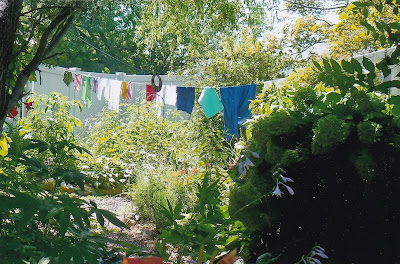
Monday is Wash Day


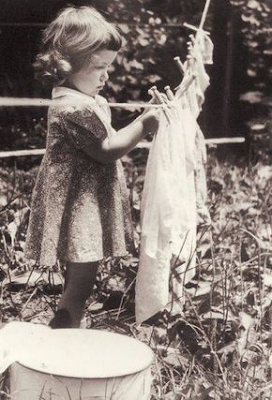
One of my sweetest childhood memories centers on Wash Day.  An older woman up the street had a granddaughter named Esther.  Whenever Esther visited, we played together.  One day, Esther's grandmother said we could play "wash day" on the back porch.  Grandma strung  twine between two porch posts, gave us a basin with soap, another with rinse water, and she even had tiny clothespins just right for little hands!  

Oh did Esther and I play that day!   We washed and rewashed our doll clothes all afternoon.  It was so satisfying when the clothes dried off in the hot summer breeeze and we could wash them again.  It was a perfect activity for a balmy afternoon.

Clearly this activity had a lot of allure for young girls.  I find photos all the time of little girls playing wash day!


Years later, I recreated that memory with my granddaughter Helena.  I had even found vintage small clothespins to hang the clothes. 

Fortunately, she was here every week day so she actually understood the concept of a wash line.  So many kids don't these days!

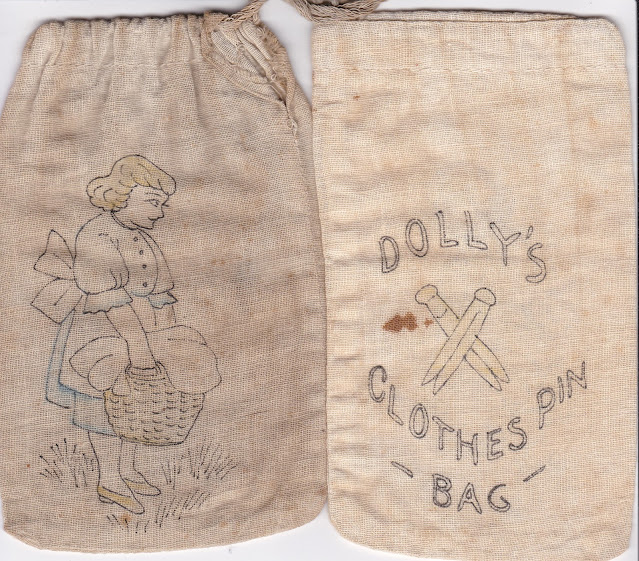
If you have a granddaughter/niece/ little one, don't forget about this wonderful activity!  And if you find small clothespins, you might want to make a small clothes bag like this one below:

The bag is small, only 4 by 7 inches completed.  One side has the girl with her wash basket, the other the words and pins.  Judging from the quality of the motif, I suspect this was from the early part of the 20th century.  I am now thinking that I will create the bag (soiling was already on the bag and is likely from age) so that when my niece Remi gets older,  she too can play wash day!

Have a safe and happy day!


Friday, August 19, 2022

Flower Friday: August 19, 2022


Happy Friday!

Today we have a nice selection of photos from Sue!
Thank you Sue!

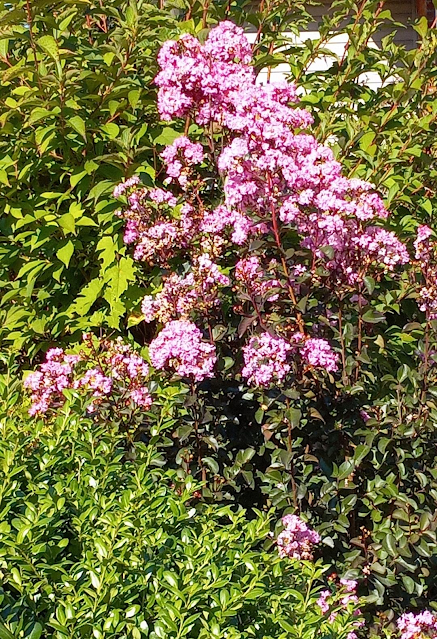
Here's Sue's crepe myrtle:


I had to look this plant up! 
It's False Sunflower and it sure is pretty!

I love these photo Sue took.  The light is so interesting and the photo below of Rudbeckia and Phlox just sings "end of summer to me."


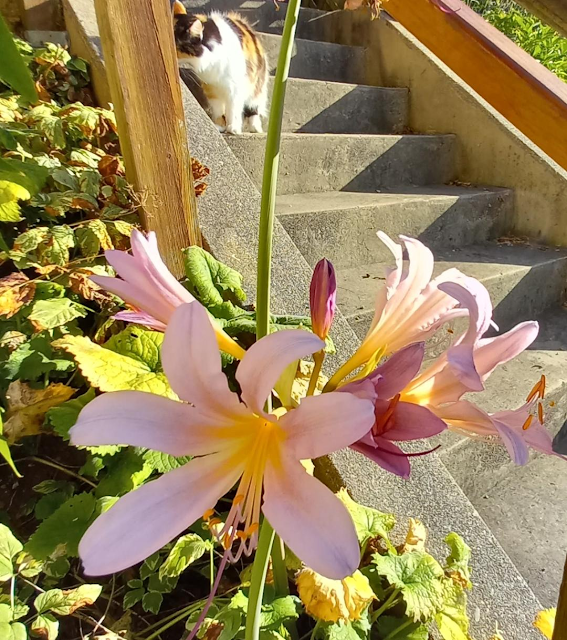
My favorite photo of Sue's is this one of her perennial amaryllis--and the fact that the picture was photobombed by Maggie May the cat ๐Ÿ˜


UPDATE:  Libby was in Pennsylvania last week and visited the Grand Canyon of Pennsylvania!  Here's a photo of the lovely view at Leonard Harrison State Park!

***

Over here in our garden, we had some sad tidings over the weekend.
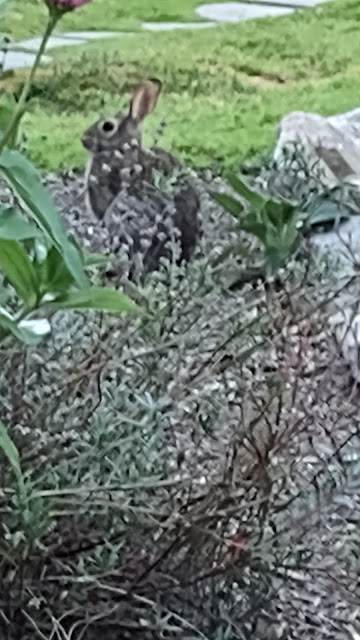
The fox snuck into our garden Saturday night and ate all the bunny babies.  Mama bunny camped in our garden for over 3 long hours and tried to figure out what happened to the babies.

On a happier note, the cleome is in full bloom and always makes me smile.  When Nana Betty became too infirmed to garden, I would take large bouquets to her to cheer her up.  One day she called me and asked, "Tell me about this alien flower.  I just love it-- it's so unusual!"

It took a while to figure out what the alien flower was--cleome.  She never remembered the name but from then on it was just "alien flower" to the family!  ๐Ÿ˜‚

Have a safe and happy weekend.  
Wishing rain for ALL us!


Thursday, August 18, 2022

"Sixty cents a yard for MUSLIN?"


Happy Thursday!

As most of you know, I write most of my blog posts well in advance of the date they are published.  The one exception is Flower Friday.  It seems inevitable that occasionally I would find another blogger writing about the same thing I do.  That happened this week.  Today's post was supposed to be about cotton shortages during and after World War 2.  

Barbara Brackman beat me to the punch.  Her article was published this past Monday.  Now it isn't like I'm psychically linked to Barbara.  I suspect she has been studying the world wide drought and the impact on not only our food but on cotton production.    Anyway, her post is better than I could have written.  It is here if you want to read it.  I suggest you do.

So I decided to write about something other than cotton today but the universe intervened.   Quilter Mark Lipinski posted a video from a 1957 movie called Shoot-Out at Medicine Bend.  He was nostalgic about shopping for fabric in the 1970s.  

All day, I kept hearing in my head, one line from the movie clip he shared: "Sixty cents a yard for muslin?"  

 
Here's the scene:  Two mature women are in a general store.  The proprietor (who looks shady) asks the ladies what they like.  They tell him they want bleached muslin. The proprietor hands them a bolt and says, "here you go ma'am.  Sixty cents a yard."  The woman is shocked:  "Sixty cents a yard for muslin?"  The bad guy tries to convince the women that it is the "best price this side of St. Louis."  But the women are irate:


"I'd have got a better grade at Elam King's for 40 cents a yard!"  The women leave in a huff.  ๐Ÿ˜๐Ÿ˜

So kudos to Hollywood for knowing that there are different qualities (grades) of muslin.  Any self-respecting sewist who watched this movie at the time would know this proprietor was a bad guy.  SIXTY CENTS A YARD FOR MUSLIN?   Bleached muslin wasn't that price when the movie was made in 1957:

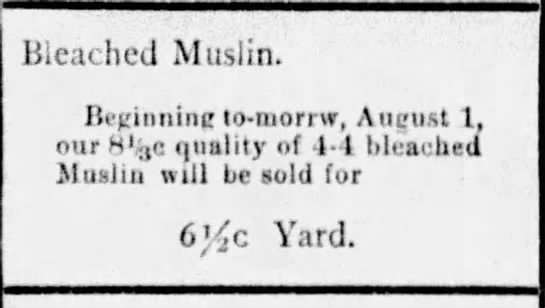
Unfortunately this movie is supposed to capture the time frame for the Old West.   Prices of bleached muslin in 1890:


๐Ÿงต๐Ÿงต๐Ÿงต


If quilting is therapeutic to you, then the status of cotton is something that I hope you will be interested in.  I'm not leading a charge for you to buy bolts of fabric, but you might want to consider the status of the 2022 cotton crop. 

The three major cotton producers are (in order): India, China, and the U.S. trails behind third.  Drought is particularly impacting U.S. cotton crops.  In July, the USDA predicted that three of every 10 acres of cotton will be abandoned due to weather challenges. ๐Ÿงต๐Ÿงต๐Ÿงต Interesting tidbit I read:  Cotton is not a water intensive plant.  It actually thrives in dry and hot conditions (see this great article).   Still the high heat is inhibiting pollinators and it appears that each of the largest producing cotton countries are facing weather related challenges.

Will prices rise?  It's hard to say.  Earlier in the year, economists predicted that the price of cotton might fall due to lack of demand.  Still, it seems likely to me that cotton prices will go up this year due to a variety of economic factors that no one can control (weather, recession, etc.).

I do suggest looking through your stash for fabric you may need to complete projects.  

That brings me to my next question:  do you have staples in your stash that you need regularly?  This might be the time to consider what you will be using in the coming year.

My staples are three things:  Kona White cotton, Kona Black cotton, and Aurifil thread (in white, grey, and dark grey).  The Aurifil I learned from you years ago (and thank you very much), when I requested information on thread that doesn't gunk up my machine.

A few months ago, Linda had suggested that this should be scrap summer.  I've been using up scraps like crazy and also taking note of what I have in my stash.  I had forgotten that I had a few hundred (not exaggerating) juvenile four-patches.  I divided the blocks into three categories: gender neutral, more feminine, more masculine.  


If I alternate these blocks with a bleached muslin, I should have enough to make a substantial dent on my list of quilts for the children.  I'm thinking of ways I can make my stash go further and if you have any ideas, please share them with the rest of us!

Tomorrow is Flower Friday and I would love to learn what is growing in your garden.

Have a safe and happy day!


Wednesday, August 17, 2022

Pomegranate Quilt Patterns


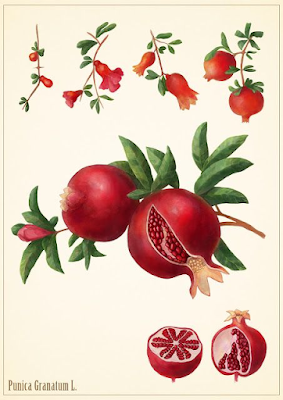
Pomegranate, it's an ancient fruit that has become one of the "in" fruits this past decade.  My husband likes the juice on occasion.  I'm not crazy about it but I think it is fruit that is pleasing to look at; apparently so did our foremothers.

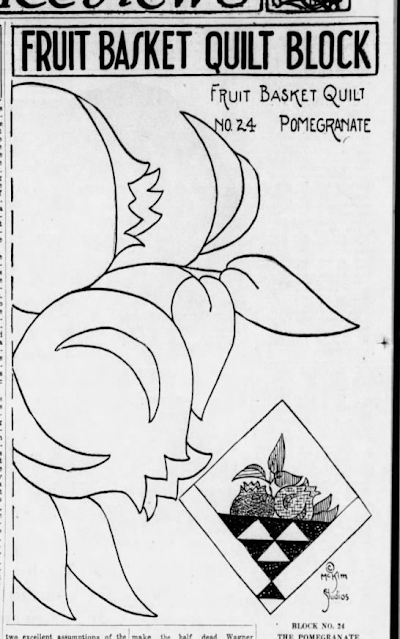
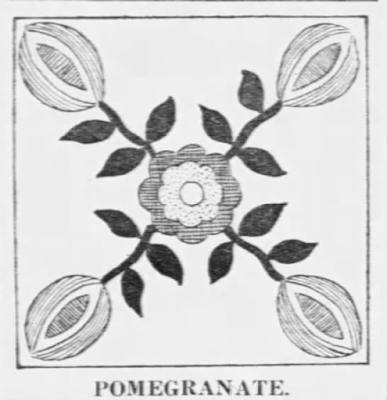
Pomegranates are another common fruit that our foremothers like to capture on their red and green quilts of the 19th century.  Often, we can distinguish the difference between the pomegranate pattern and the love apple fruit by the jagged edge along the end of the fruit (technical term=persistent calyx).  Ruby McKim made note of this on her 20th century rendering of the fruit:

But there are many motifs that don't have that jagged edge.  Those patterns look an awful lot like the love apple and I wanted to point that out to you.  Here's a 1934 version rendering of a 19th century pattern:

This version is very similar to a 19th century version of a Ladies Art Company pattern called "Peony and Pomegranate"; the Peony is in the center.

In general, patterns can be deceiving in their appearance.  There's another pattern that has a fruit with one edge jagged called "Pumpkin Seed"--I couldn't find a photo of the pattern but it's a wreath with what appears like fruit (with jagged edges) surrounding a wreath.  

We often want to be able to glance at a pattern and know it's name--and often we do.  But applique patterns can be tricky.  If you are interested in this kind of study, I suggest you buy Barbara Brackman's Encyclopedia of Applique Quilt Patterns.
Appraisers use Brackman's resources for this very reason.  I've had quilts appraised that the appraiser has said, "I need to research this pattern more" before telling me the name.

If all that isn't confusing enough, there is the word variation of used by appraisers.  Sometimes Great-grandma made her own version of a quilt pattern she had seen and her rendering doesn't quite match the documented patterns we study.

Do you like red and green quilts?  I have some friends that are just crazy about them and the quilts usually expensive because of the demand.  Do you have any you would like to share with us?


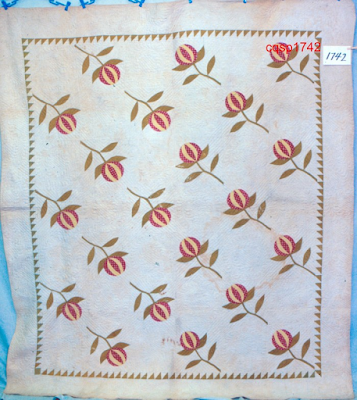
On sale at Etsy right now is this 19th century "pomegranate quilt."

Have a safe and happy day!


Tuesday, August 16, 2022

Tuesday's This and That: August 16, 2022

 Happy Tuesday!

It's hard to believe that it's mid-August and almost time for the kids to go back to school!

Last week I posted photos of some of my star quilts.  Robin shared with me a post she had written on some star quilts she inherited from her Great-Aunt.  It's a wonderful post full of photos and history of her Aunt Mollie.  Please go over and visit it here.  

The second star quilt photo has an unusual aqua incorporated into the stars.  I think that fabric might be what we call "centennial green" and unusual aqua that appears to have only been sold around the time of the Centennial in 1876.  

These quilts are wonderful treasures.  Robin, I would suggest you have them all officially appraised if you can.  They are treasures!!!

Do you have any antique/vintage star quilts?  Please share as I think that many of would appreciate the inspiration!

Have a safe and happy day!


Monday, August 15, 2022

Tomato Quilt


The tomatoes are coming in!
It's my husband's favorite time of the summer.  He eats corn on the cob and fresh tomatoes as much as he can.  Last weekend, we noticed that we had a good half dozen tomatoes that would soon be a bright red.  "They'll be all ready when we get back," my husband said.  We rejoiced that our garden has been squirrel and chipmunk free for the past few months.  

Unfortunately the critters heard us.

They got all the tomatoes except for one.  Sometimes they don't even pick them off the vine.  Just take one lousy bite and then move on to the next one.  My neighbor said they want the red ones because they need fluids and the juice helps the animal.  Yes we haven't had much rain and the temperatures are oppressive. 

"Leave a bowl of water out for them," my neighbor advised.  Oh yeh, we did that...and our outdoor camera recorded a menagerie of wildlife coming to the garden for a drink:  rabbits, feral cats, foxes and skunks.  And guess what?  The freaking squirrels still ate the tomatoes.  We took the bowl away.

So we are back to harvesting tomatoes as soon as they show color.  Actually, for those of you who face similar challenges, this article here may be of some interest.  It's actually best to pick tomatoes once they begin to show color and it explains the science and how to ripen tomatoes indoors.  It's very interesting.

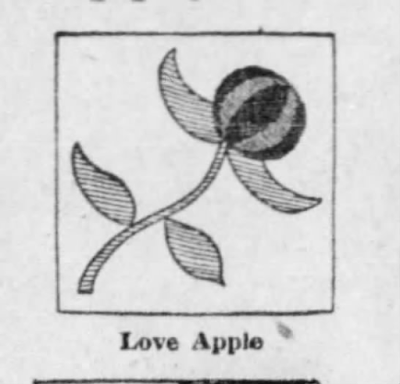
But let's talk about tomato quilts.  Actually any of us that have viewed 19th century quilts--particularly the red and green applique kind--have likely seen a tomato quilt.  That is because another phrase for tomatoes is Love Apple.

Brackman has 4 versions of this pattern in her Encylcopedia of Applique.  Here's a couple versions I found on the internet:


The "Love Apple" pattern had staying power.  It was promoted by various designers in the 1930s:


1932, Detroit Free Press

 1933 Palladium Item, Indiana

Another pattern by Nancy Cabot can be found at this blog here.

So why were tomatoes called Love Apples?

Apparently the French thought that tomatoes had aphrodisiac properties and so it was referred to as pomme d'amour (or love apple).  Tomatoes were native to South America and it was only when that continent was being explored that the fruit was brought to the Old World (Europe); still it took a few centuries before Europeans completely embraced the fruit. 

Prior to the pandemic, when I was still traveling and giving programs, I often visited the Love Apple Quilt Guild in New Jersey.  The name of the guild made perfect sense to me.  New Jersey is the 8th highest producer of tomatoes--which is saying a lot since it is also the 4th smallest state.  There is something about driving past the tomato fields in that state that is really charming.  All those pops of red in a green field really takes one's breath away.  By the way, the tomato is the official vegetable of New Jersey (despite it being a fruit--the blueberry is the official fruit of the state).


Nancy Page, 1942

Maybe you are similar to me and always wondered what that striped aspect of the fruit on the quilt pattern meant?  I mean is it just a shading technique?

Maybe our foremothers were telling us to pick the tomato before it completely ripens and the squirrels or the chipmunks get it.  ๐Ÿ˜‚

Have a safe and happy day!