Wednesday, March 4, 2020

The Elusive B. M. Boye Part 2

Bertha Margaret Boye spent her lifetime creating art.  Despite all the accolades and exhibits she did, the only image that I can find of her work is her suffrage poster.
One of the challenges in writing about women is that often, their work was not valued after they died.  Even today as I research local suffragists, it surprises me that so few of their obituaries mention their suffrage work.  

One writer speculated that the woman figure in the suffrage poster was Mexican American and that her cloak was Native American tribal garb.  I haven't found any proof to support that theory.

Bertha's image remains unlike other suffrage illustrations:

There is a spirituality and serenity in her poster; it defies the  stereotypes often used by Antis.


I often refer to Bertha's suffrage poster as "Our Lady of Suffrage" because it reminds me of the statues of the Blessed Mary that were often in the gardens of members of my family.
 I don't know what faith Bertha practiced but I do know that she was active in St. Mary's Catholic church in Ukiah.  She assisted with chaperoning and organizing a girls club called the "League of the Little Flower" at the church.  In 1924, it was reported "she was devoting her time for the next few months, in designing figures and placques for the niches in the new St. Mary's Catholic Church.
The church is now a school of performing arts.
I think she would like that.


Monday, March 2, 2020

The Elusive B. M. Boye Part 1

Those of you who have seen my Storytime Stiches program are aware of my fondness for women artists and illustrators.  One reason I'm so passionate about this subject is because women were excluded from the fine arts for so many centuries.  Because there is not much available about this particular artist, I wrote an especially lengthy post about her life.  Today is part one.

Probably the most popular suffrage poster was created by Bertha Margaret Boye (1883-1930).

This piece was the winning entry for a California suffrage poster contest in 1911 and part of the successful campaign for women's suffrage in that state.  Berth was born in Oakland, California but grew up primarily in San Francisco.

She was a gifted artist, a bit of a recluse, and most importantly, she knew the value of her work.  I suspect she was one of those  artists who was married to her work.  In college, when the school newspaper chose to publish one of her illustrations, she insisted on being paid $25 for her artwork.  This made headlines in the Oakland Tribune.  Unlike other women artists who were often exploited, Bertha stood firm and understood the value of her work.

A year later in 1906, Bertha was commissioned to do a sculpture H. P. Baldwin a well known businessman in Hawaii.  The drinking fountain, completed in 1907, memorialized Baldwin's late grandson.  Hawaiian newspapers described the fountain as a child holding a cup:  "The design and execution of the fountain are extremeley graceful, the child's contour showing good expression."  Later references to this work indicated that she had received much acclaim in the art world for the piece.  I just wish I could find a photo of it.

Artistic losses occurred for Berths during the San Francisco Earthquake and Fire of 1906 when all her work was lost.  She continued to work after she found a new studio and was a member of the Sketch Club (later renamed the San Francisco Women Artists).  She exhibited frequently with this group and in 1909 illustrated a children's book called Dotty Seaweed.  I've never found a copy of this particular book but shortly afterwards, she did illustrations for a book entitled Jingles for Singles, a romantic and sentimental version of nursery rhymes.


Bertha's work continued to be exhibited and in 1911, her suffrage poster was submitted to the College Suffragists for Design; her piece won the $50 prize and was featured in California department stores along with suffrage flags and Equality Tea.

In the same year, Bertha won another poster contest (and $100) for the San Francisco Fall Fashion show.
One interesting aspect of this piece is that Bertha had hidden her phone number, 5062, somewhere in the piece.  

Her work continued to receive accolades and interest.  In 1912 she travelled to Europe where she studied art and sculpture in Munich, French art academies and even with Anders Zorn, a well known sculptor and artist from Sweden.

By 1919, Bertha had moved to Ukiah, California and set up a studio and private art school.  It was a secluded setting for an artist but she later explained her reasons to a reporter:

"I did things several years ago.  A memorial fountain for a man in Honolulu, some illustrating and I exhibted a few things in San Francisco but after my return from Europe I came here to rest and was charmed by the place and, while Intend doing some work for the public--for I feel the urge to go ahead--I enjoy the prolonged rest, my class of children, my Indian models, and maybe most of all--the privilege to keep my little family of animals thtat I love and enjoy so much in modeling."

Bertha had a special relationship with the local Native American population who also appeared to be very protective of her when outsiders sought to meet her.  A special exhibit of her work was featured at a local residence:  "Miss Bertha Boye's group of Indian figures and a few of her studies of Indian life were shown.  The work all bears the distinct touch of the true artist executed in designs not before made and the work made a tremendous impression on the visitors.  To add to the pleasure of the event Miss Boye was there in person to meet the guest."

A rare photo of Bertha.
In 1923, a special exhibit featured Bertha and well known artist Jennie V. Cannon, another California artist.

A year later, her work was featured in Paris:
Bertha had become ill in 1927 and did not return to Ukiah until May of 1928.

In 1930, Bertha traveled again to Europe to tour and study.  She was in Madrid in April but in September passed away suddenly in France.

More on Bertha tomorrow!


Tuesday, February 25, 2020

Automobiles and Suffrage

The automobile was an important tool for suffragists.  Not only did it mean that women could travel for speaking engagements but they would often use the car to gain attention for the cause.


Cars were so important that in 1913 when the first suffrage school was opened (see here for a post on that), a special course was devised about speaking from the automobile.


Cars were decorated to relay the suffrage message during pageants, parades and other events.  


Speakers used the cars as a platform; it was also a good getaway tool if the audience became violent or hostile.

My favorite discovery (and I seem to find them daily when it comes to suffrage) has been "the Yellow Flying Squadrons" that traveled around Philadelphia and the eastern part of Pennsylvania.  Suffragists decorated their cars and created an impromptu parade in neighborhoods and towns to spread the suffrage message. 

"Flying squadrons" had been used throughout the early 20th century by all the suffrage groups.  

Newspaper articles reported that once the squadrons entered a neighborhood, a festive tone was set by the children who would begin to yell and applaud.  Their response would bring out the adults who would alert neighbors.  I wondered as I read these accounts if the adults were thinking "look at what these crazy suffragists are doing now."

Still it was an effective tool to keep the message in the public's eye and it always seemed to get publicity in the local newspapers.
Have a great day!


Wednesday, February 19, 2020

Big Top Suffragists

Circus quilts were popular for kids through the 20th century.  There's a wide variety of them that you can look at online.

During the early twentieth century, the circus was one of the most exciting events that occurred in a community.  A friend's father, who is nearly 100 years old, has talked about when the circus came to town.  Children were given time off from school so they could see the circus parade as the performers and animals traveled from the train depot to the location where the tent was set up.   

Along this route, the animals and circus folk performed as they traveled. They regaled the audience and drummed up free publicity. 


For many communities this was the only opportunity to see exotic animals and daredevil feats.


In 1912, a new group of women joined the ranks of the suffragists--the women performers of the Barnum and Bailey Circus.

"The circus women live in a little world of their own, " said Miss DeMott the president of the circus women's suffrage association, "roaming all over this country, and sometimes the world...We discuss the laws of the different States we visit.  From these debates we feel sure there is no other who needs the franchise more than ourselves.  And there is no class of women who could be of more assistance to the cause than we women, who are constantly travelling."


DeMott went on,  "there is no class of women who show better that they have a right ot vote than the circus women, who twice a day prove that they have the courage and endurance of men...We are all part of a great sisterhood, and that is what suffrage is."

The formation of the group was widely publicized in the United States and Canada.  There was even a baby giraffe named by the women, "Miss Suffrage."
Equally publicized was the reaction of the one of the men of the circus, a Mr. Seabert who stormed into one meeting and insisted his wife leave the meeting.  When the other circus suffragists booed him he retorted he "wouldn't have my wife participating in this nonsense...and I'm not going to wait all night for my grub."

Miss DeMott asked another performer, Katie Sandwina, "what would you do if your husband came here and ordered you away?"

"I'd put him out," replied Sandwina calmly. 

Katie Sandwina was the strong woman of the circus.


Monday, February 17, 2020

Happy President's Day!

At the beginning of the Civil War, a group of women and a few men in NY assembled to discuss what they could do to help the war effort.  The Sanitary Commission of the United States was the idea they came up with and yet the idea of citizens (particularly women) assisting in war efforts was not taken seriously in Washington.

Lincoln himself dismissed the plan as "a fifth wheel on a carriage."  

The truth is that the Union was unprepared to clothe, feed, and support a large army of volunteer soldiers.  Women from every background worked hard to support the effort by providing proper food, quilts, nursing care, and most importantly, raised funds.  "Sanitary Commission Fairs" particularly on the east coast raised millions of dollars---that's million of dollars back then--for the war effort. Estimates of the total assistance they raised in goods, services, and funding is now considered to be in the billions.


Sanitary Commission Fair


Suffragists put their campaign on hold during the war to join the war  effort.

Women also kept the country functioning by assuming the roles previously held my by men such as teaching, secretarial work, and industrial work--even if munitions factories and arsenals.
On September 17, 1862, the Allegheny Arsenal near Pittsburgh Pennsylvania exploded.  78 workers were killed--mostly young women--including 15 year old Catherine Burkhart and 17 year old Margaret Turney.


As the war continued, Lincoln admitted in a speech in 1864:

"I have never studied the art of paying compliments to women; but I must say that if all that has been said by orators and poets since the creation of the world in praise of women were applied to the women of America, it would not do them justice for their conduct during this war.  I will close by saying, God bless the women of America!"

Friday, February 14, 2020

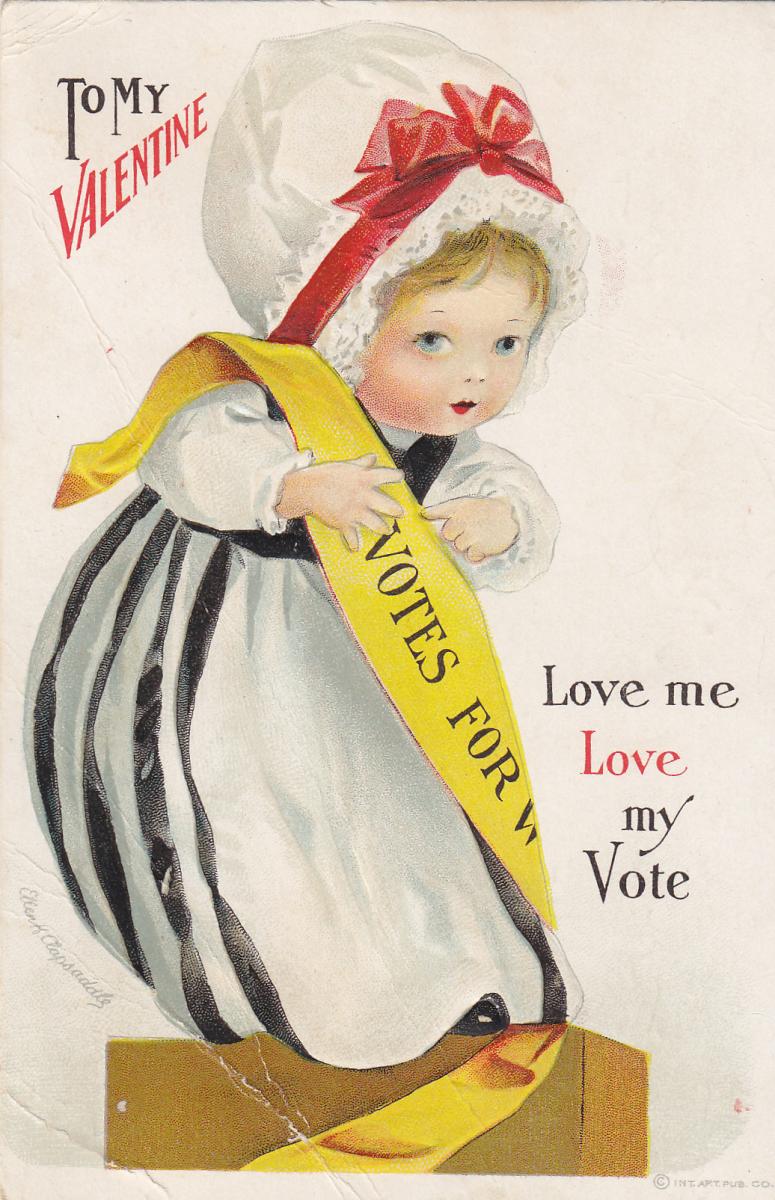
Happy Valentine's Day!

Happy Valentine's Day!

 
There are a lot of valentine's day greetings that were suffrage related!
Some like the one above are pretty pathetic.  Give me the vote or marry me?  Maybe there was a threat there, I don't know :)

But the best story I found was this one from 1915.  In that year there were four states that had suffrage on the ballot for the (male) voters to decide.  This was part of the campaign in Pennsylvania.


Tuesday, February 11, 2020

Suffrage Quiltmaking and Service

The more I research suffragists, the more I am inspired by the many services they bestowed on their communities.

Americans have a long history of longing for isolationism but the truth is that no country lives in a vacuum and long before "global economics" became a catch phrase, there were certainly examples of how international events could impact another country.

In July of 1914, World War I broke out and despite the lack of U. S. participation, ripples of the war impacted families in the U.S.  By winter of 1914, thousands of sailors and longshoremen in Brooklyn, NY were idle because of the impact of the war.  It was particularly devastating to the families of the longshoremen:  "because they live hand to mouth at all times."

Many charities stepped up to help the families, not the least of which was The Woman Suffrage Party.  By December, the women had prepared hundreds of baskets of food and supplies to help the poor.


Later reports stated that the more baskets they filled, the more poor they found.  On Christmas day, the suffragists also set up 3 stations and gave out free bread to the needy.

Despite the women's initiatives, it was surprising to find that other charities refused the assistance of the suffragists because the baskets each had yellow ribbons and tags on them.


The suffragists were undaunted and in January they began a quilt drive to provide quilts to the needy of the region.  

"The actual cost is only the cotton wadding, plus a few hours of work; and the result be great comfort, perhaps even life, to some our citizens.  One thick quilt to a family might mean a staying away from the municipal lodging house in a cold snap.  It would be as good as filling of the coal box.  And best of all, it is the utilization of waste material."  

It is interesting that the technique to make these quilts went into great detail.  The women suggested using 3 lbs of cotton wadding to fill each quilt.  The technique suggested for quilting was actually tying the quilt; this seems to be a favored technique for charity  quilts needed in a hurry:
 A tied comfort from my collection.  The women around here often used wool circles to keep the string from damaging the cotton. 
It appears that the longshoremen did not forget the kindness of the suffragists.  In August of 1915, suffragist Oreola Haskell was interviewed.  She was a well known speaker and writer and recounted how years earlier, speeches by suffragists could incite riots.  Oreola elaborated about a recent experience:

"Do you know the audience I enjoyed talking to most?  A few weeks ago I spoke to a crowd of longshoremen.  It was luncheon hour, but still nearly every man missed his luncheon to come to hear us.  It was the nicest, most considerate crowd I have ever spoken to.  When we gave out our pamphlets every man took them--and I know that every man read them. "

This story warmed my heart and I hope it warms yours!  Have a great day!