Showing posts with label part 1. Show all posts

Wednesday, February 23, 2022

Aprons...All Tied Up, Part 1


My mom and I have been talking about aprons.  

Mom:  "Do you know who never wore aprons?"

"Of course," I respond.  "Nana Elsie (my Dad's mom).  I never saw her wear an apron--and then again, I never saw her wear slacks either."

Mom's mom, Nana Betty, always wore an apron--always a half one.  It served a variety of purposes: tea towel, hot pad, and rubbing something that suddenly needed cleaning.  Great Grandma always wore this big apron that resembled a dress--similar to this:

My mother always wears an apron in the kitchen.  I'm not a big apron wearer especially because I don't do much baking anymore.

Do you wear aprons?  Do you have fond memories of family members wearing aprons?

Mom and I were talking about this because every now and then, in an old magazine or newspaper, I will find a reference to a specific type of apron that befuddles me.  Last week the reference was "the fudge apron" in an early 20th century newspaper.  ðŸ˜•😕😕  Did one need a special apron to make fudge?

So after studying newspapers and magazines, here's my theory and it applies to specialized aprons.  There are very few types of aprons sold or featured in articles in the 19th century that included a purpose for the apron.  Most of the ads and articles instead focus on the fabric used to make the apron like gingham aprons, linen aprons, cambric aprons.  It seems like towards the end of the century more and more articles featured aprons that were embellished with doo-dads:
1893

But in the 20th century, it seemed like there as an apron allotted and sold for every purpose.  In 1917, "a bathing apron" was discussed:  "A pretty gift for a the mother of a small baby is a bathing apron made from a Turkish towel."  An earlier article (1903) suggested the bathing apron be made of flannel.

The mysterious "fudge apron" was probably named after the confectionary.  Fudge became popular during the late 19th century (at colleges of all places).  By the 20th century, so many fudge recipes had been printed in newspapers, that some readers complained or even made fun of the fudge makers:

I honestly don't know what's funnier to me...the fudge controversy or that the writer signed herself as Lady Macbeth.

 ðŸ˜‚😂😂
One fudge apron pattern from Royal Society, no date known:

Perhaps more intriguing is this pattern from a 1915 children's magazine:

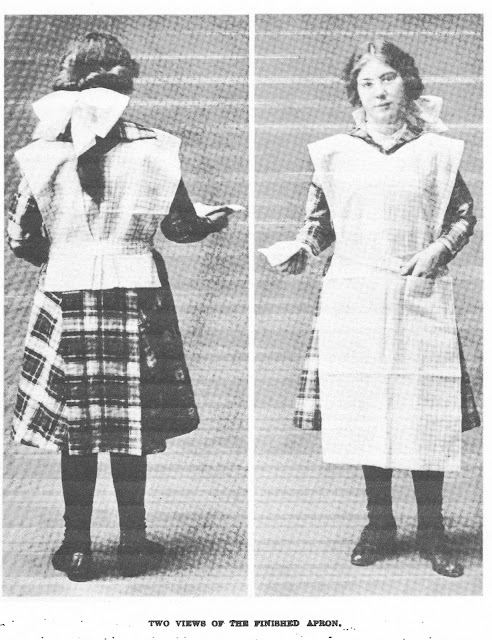

Most of the articles and ads I found were selling "stamped fudge aprons" for women to embroider.  

This of course begs the question, why do all that embroidery for the apron to just get dirty?  Apron lovers will think I'm a heretic for that question.

But wait!  There's more!  Stay tuned for more thoughts of other various aprons!

Have a safe and happy day!


Wednesday, November 3, 2021

Story Time Stitches: Absentees, Part One

 No study is complete without looking at the big picture.  My research on this topic continues to be ongoing.  Just over the weekend I noticed this quilt on ebay and thought to myself, I bet the maker used a coloring book for the pattern.  

But we also want to look at what is missing from quilts and children's literature.  It's a big topic and can be very surprising and even a bit sad.  I'll break this down into a few posts for you.

1.  

There were a lack of books published that featured non-white children in a respectful way.  It is reflected in our quilts and patterns of the 20th century.  It wasn't until 1962 that a book by a white man named Ezra Jack Keats was published that proved that a children's book with a non-white child could be successful.  The book was called The Snow Day.  It was awarded the highest honor for illustration in a children's book, The Caldecott Medal.


Despite the accolades for this book, it was still controversial and even banned in some places.  Some felt it didn't portray African Americans in a positive way.  Others felt that the writer couldn't or shouldn't write about an African American boy because Keats was white.  Still--after reading the book to her class, one teacher told Keats that for the first time, some of her children were choosing brown crayons to depict themselves.

Although there are more children's books offered that feature children of various ethnicities and colors, our quilting fabric manufacturers still feature predominately white children in juvenile prints.  

It is getting slightly better but for the last 20 years that I've made donation juvenile quilts, I've always tried to feature animals and other motifs instead of children because I don't know who the child is that will receive the quilt.

I would like to see fabric that encompasses the spectrum of kids in our country.  The kids in my own family are Asian American, African American, and white.  

Here and here are great articles discussing Keats' book and the impact it made.

🕮🕮🕮

Another exclusion that has since been corrected in books (but not our fabric choices) are children with disabilities.  Years ago, we could donate Project Linus quilts at a local craft store.  I was very active in the collection of the quilts and homemade blankets and would deliver them to the hospitals.  Wouldn't it have been nice to deliver a quilt to a child in a wheelchair that depicted a child in wheelchair?  One notable exception is Robert Kaufman's "Bright Days" fabric:


This is fabric that I must have for my next donation quilt!

Have a safe and happy day!

Wednesday, June 2, 2021

Story Time Stitches: Connections, Part 1


1.

Storytelling may be the oldest of arts but finding images on quilts that reflect popular books--particularly children's books--is a relatively new phenomenon.  A number of factors culminated to form the illustrated and colored children's books that we find copied onto textiles.

2.

The first factor was the Industrial Revolution.  Because of the rise of factories, a middle class arose of bureaucrats,  merchants, and skilled workers.  As economic opportunities increased a new set of social standards were created.  

3.

Women were now considered the abiters of taste and the moral keepers of the home.  Discussion on women's rights and independence fermented.  By the end of the Civil War, "female" colleges were established throughout the United States.  Many women sought financial independence.  One writer has suggested that there may not have been much resistance to women working because of two reasons:  the astonishing loss of men during the Civil War and the fact that many men may have not wanted to support unmarried women family members.  (4)

As the women's movement in the the United Kingdom and the United States evolved, women were finally given a place in the arts--not the fine arts--but illustration became one of the acceptable areas for women to work during the last quarter of the 19th century.

The Industrial Revolution also contributed to many improvements in various industries.  Sewing machines became more affordable after the Civil War and provided women more leisure time.  

In 1875,  William Briggs patented the first iron-on embroidery transfers in England.  His patterns were marketed in the United States and were immensely popular.  Pictured below is one of his transfers:

Women no longer needed to know how to draw in order to embroider images on quilts and linens.  In the 19th century, embroidered transfers were often incorporated in what I consider to be the first two national trends in quilting:  crazy quilts and redwork.  By the end of the 19th century, there were even books that encouraged women to use iron-on transfers to establish their own businesses:

5. Dainty Work for Pleasure and Profit

Book publishing also improved and colored illustrations could be included in a variety of books--even those for children.  After the Civil War, more magazines for women emerged.  Women read about a variety of topics including child rearing, domestic matters, and sewing.  Many magazines even included free patterns that women could incorporate in their sewing.

(6)
But the population that was most impacted by the changes in society were children. 

In lectures I sometimes joke that the Victorians invented a thing called childhood.  With the changes of family life and the influence of Queen Victoria (both in the U.K. and here), attitudes towards children softened.  Children were no longer "born bad and had to be made good." Instead they needed protection and their young lives were viewed as having a seperate stage of life that required special care.  (7)

Children were still disciplined but in a measured way.  Most of all, a new territory in the household was allotted to them:  the nursery.

Education also improved.  Public schools were opened in the 19th century (versus religious institutions) and the Department of Education was established as a government branch after the Civil War. Libraries reflected the social attitude and special "children's areas" were created that encouraged children to read.

These changes greatly changed society, not only for the children and families but also the economy.  Businesses emerged that specialized in products for children--such as toys, books, etc. 

Most importantly, it needs to be pointed out that many of these changes were reflected in families who had a comfortable income.  Childen of poor families continued to work in factories and often in deplorable and dangerous conditions.

Tomorrow I'm going to have a special part 2 of this week's series and focus on children's books and illustration.  

Have a safe and happy day!
***

1.  Cover of Good Housekeeping magazine, February, 1920.  Illustration by Jessie Wilcox Smith

2. Samuel Slater is considered "The Father of the Industrial Revolution" in the United States.  Pictured is The Old Slater Mill in Rhode Island.

3.  Fashion Plate from Godey's Lady Book (a popular magazine for women), 1859

4.  See The Red Rose Girls, An Uncommon Story of Art and Love by Alice A. Carter, copyright 2000.

5. Fancy Work For Pleasure and Profit, first published in 1893.  The book was published the same year as the World's Columbian Exposition.  The book is dedicated to  Mrs. Potter Palmer who was the "President Board of Lady Managers of the World's Columbian Exposition."   You can read the book online here.  

6.  Design by Candace Wheeler and published in Harper's Bazaar, June 4, 1892

7. An excellent book on this subject is Huck's Raft:  A History of American Childhood by Stephen Mintz.

"Story Time Stitches" ©2021, Michele McLaughlin

Wednesday, April 28, 2021

I-Spy...and Imagination Quilts, Part 1


Linda is my oldest friend.  We raised our kids together and they are still as close as siblings.  A while back I called Linda to tell her some bad news:

"Our children were neglected." 

"Do tell,"  Linda is quite accustomed to my eccentric ramblings.

"We never taught them to play the I-Spy Game."

Linda paused for only a second, "I'll bet they're all in therapy about that now."

We loved that our kids invented their own games and we both agreed that our children would have found the traditional game of I-Spy boring.  


For decades, I lived outside the quilt community.  In the 1970s and early 80, I cut or embroidered blocks, Linda often pieced them, and Nana and I would tie the quilts.  I wish I had photos to show you but it was before the digital age and that quilt album is packed away in the back of the attic.  

For those of you who are interested, the British played the traditional game of "I-Spy" in the late 19th century.  But according to one turn of the century book printed in the United States, the game was quite different and resembled the game tag:
"All the company hide, except one; who is kept blinded, until she hears them call, 'whoop!'  She then takes the bandage from her eyes and begins to search for them.  If she catches a glimpse of anyone, and knows who it is, she calls her by name, 'I spy Harriet!' or 'I spy Mary!'  The one who is thus discovered must start and run for the place where the other was blinded.  If she does not reach the spot, without being touched by her pursuer, she must take her place."  

I vaguely knew of the I-Spy game but it wasn't until I joined my quilt guild that I heard it applied to quilts.  "Nice I-Spy quilt," someone said about my children's quilt.  "What?"  The kind guild member explained the concept to me.  I was too embarassed at the time to tell her that for years I had made up my own name for my kids' quilts.

I called them "Story Block quilts" and I didn't apply the I-spy game to them at all.  I told each child that I had sewn 4 million stories into each quilt and asked if they could see any of the stories.  Each child could at one glance.

By the late 1980s, I went back to quilting when some friends at the college began to teach me the new and easier methods of quiltmaking.  

A new generation of children was also being born in my family.  One day, my niece phoned me to tell me she had just gotten a Jenny such-and-such purse.  "Is that a cartoon character?" I asked her.  She laughed and told me it was a designer and the purses usually sold for over $100.  My niece was 4 years old.  It was clearly time to make Story Block quilts for the new youngsters.


In the early 1990s, a friend opened a stall at a craft mall.  She asked me to make some Story Block quilts for her stand.  As you can see from the photo above, they aren't anything really remarkable as far as piecing.  The real magic was what the kids imagined.

Tomorrow I'll talk more about that.  I need to get working in the garden before it gets too warm!

Have a safe and happy day!