Thursday, May 18, 2023

How Do You Feel About Panels?


Good morning!

I've been wondering how you feel about quilt panels.

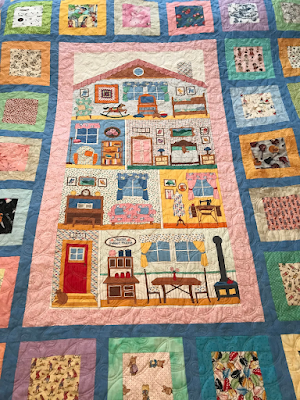
I personally have a love/hate relationship with them.  For newer quilters, a panel is a fairly large pre-printed textile, usually with a picture on it.  Here are two quilts I made using panels:
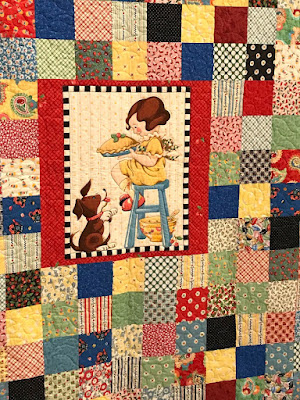


I think I'm down to two panels left in my stash.  I know I made more quilts using them but I may have forgotten to photograph them.  Often, I use vintage textiles like panels to make a mini quilt to hang in the house:


I've been wondering about the history of quilt panels.  I'm just musing but I think they were an innovation that was introduced in the 20th century.  Perhaps they were the next step beyond pre-printed patchwork (sometimes referred to as cheater fabric).

Quilt kits were sold in the early 20th century and Marie Webster was known for marketing them.  As printing techniques improved, it seems like panels were made, often for baby quilts:
 

In the 1920s and 30s, I found a lot of panels marketed for pillow covers like this one from 1935:


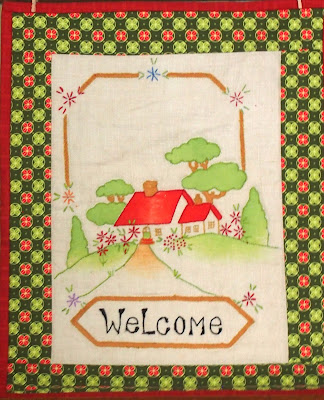
Here's a pillow cover that I think is from the early 20th century that I made into a wall hanging:
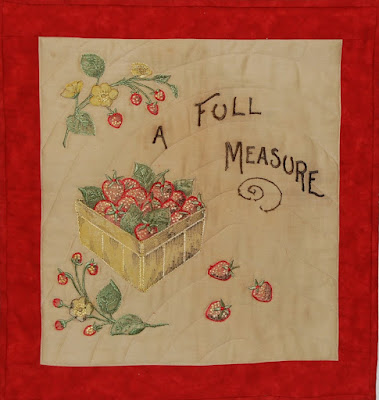

It made sense to me that in the 1970s, a lot more panels were introduced.  Often they were for babies and the similarities of the two quilt revivals of the 20th century were similar.  Making quilts for babies was a perfect way to get people engaged in quilting.

1972:


1974:
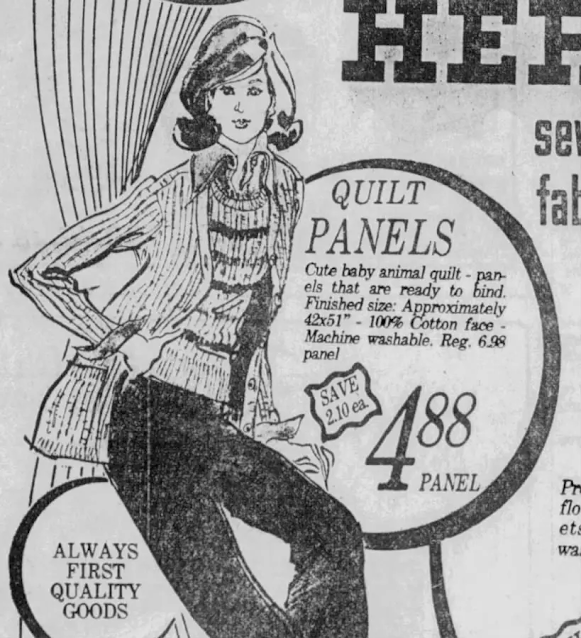

What are your thoughts on panels?  Do you like/use them?

Tomorrow is Flower Friday and if you have photos to share, please email me at allentownquilter@gmail.com

Have a safe and happy day!  


Wednesday, May 17, 2023

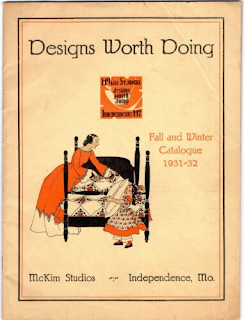
Designs Still Worth Doing: Quaddy Quiltie


In 1916, Ruby Short submitted a quilt pattern to the Kansas City Star newspaper as part of a competition to promote a children's book written by Thornton Burgess.

Burgess was a very popular children's writer.  His children's stories were syndicated and published throughout the U.S. and Canada.


When Burgess' stories were published as a book, the quilt contest helped market the new book.

1915

Ruby's patterns were published in the Kansas City Star in 1916.  Her designs are generally regarded as the first syndicated pattern series in a newspaper.  

Ruby had long had an interest in art.  Her passion for art seems to have outweighed her interest in needlework.  When I emailed Ruby's granddaughter and asked about the kinds of quilts Ruby made, Merrily wrote back:  "Grammy didn't make the quilts, she was way too busy designing and marketing the Studio."


When Ruby was young, she attended the New York School of Fine and Applied Arts (now Parsons School of Design).  She appears to have been greatly impacted by the philosophy of Frank Alvah Parsons who felt that art should be accessible to everyone.  Ruby graduated in 1912.

You can see some of Ruby's paintings here on the McKim Studios website.

Ruby returned home and taught art in locals schools.  She even became the Supervisor of Drawing for the Independence School System.  Many sources site that it was a good thing her designs were accepted by the Kansas City Star.  In 1917 Ruby married Arthur McKim and as a married woman, could no longer work at the school.

What's A Quaddy?

Well the word "quaddy" is a nickname for a quadruped:  an animal that has four feet, especially an ungulate mammal (with hooves).  It's a weird term to use but was probably more known more at the early part of the 20th century.  Burgess' characters were actually more woodland animals (including reptiles and birds).

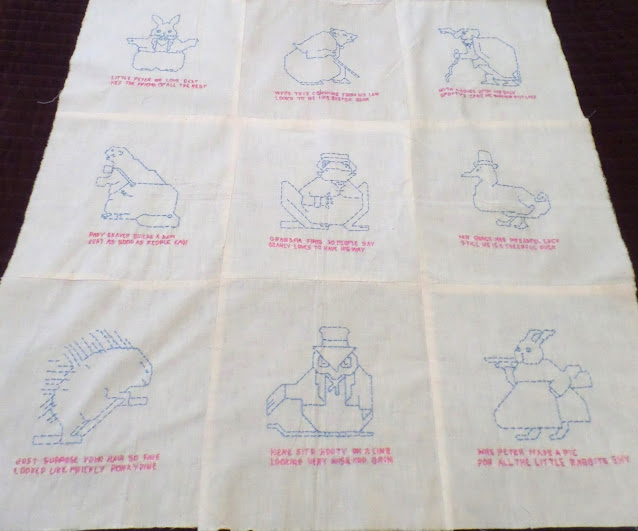
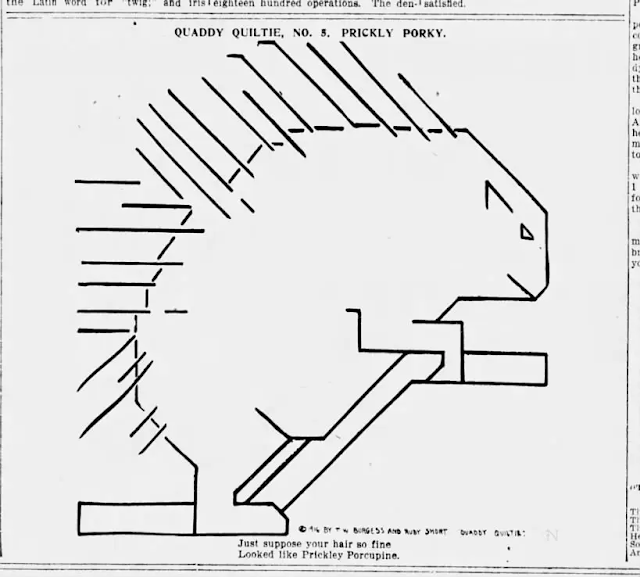
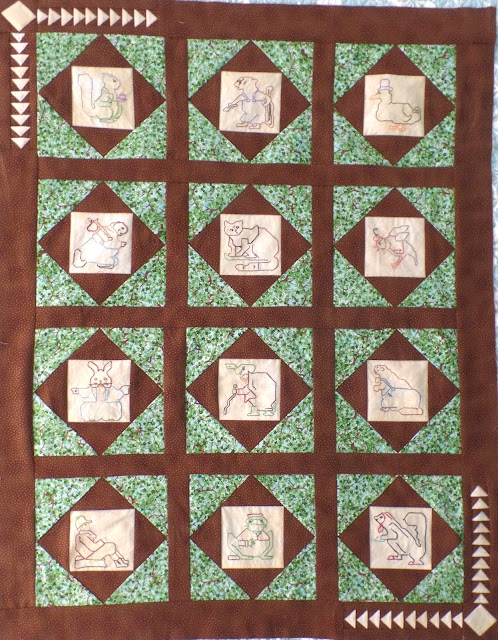
Ruby's designs rendered her animals in an angular manner:


The patterns were meant for not only adults to make but especially for children to sew.  As a school teacher, Ruby was well aware that embroidery was part of the curriculum in schools.  In fact, an 1898 manual from a Normal (teaching) School cites:

"(embroidery provides) an educational means by which the brain is developed through the use of the hand..."

Today we refer to that as "hand-eye coordination."  The patterns were meant to be traced onto fabric.  The angular nature of the characters were easier for youngsters to trace and sew.


Above:  a quilt top from my collection.  What I like about this piece is that it includes the description of the character embroidered beneath the image like the original syndicated pattern.  Many of the quilts made later just featured the animal.  


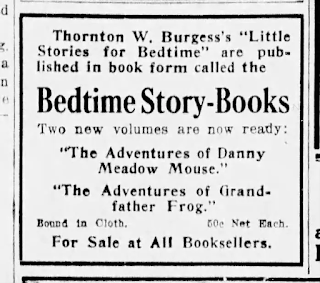
The quilt could also be made from pre-printed squares.  This ad ran in 1916:


So the question is--would children today find these characters endearing yet?

Well yes they did but then it is the 21st century and the question I received from neighborhood children was why the characters were only depicted with blue thread.  They wanted color on their animals.

So I made a wall hanging of more colorful embroidery:


My young audience preferred the more colorful embroidery but wanted to know why I hadn't colored in the animals (everyone's a critic 😄).

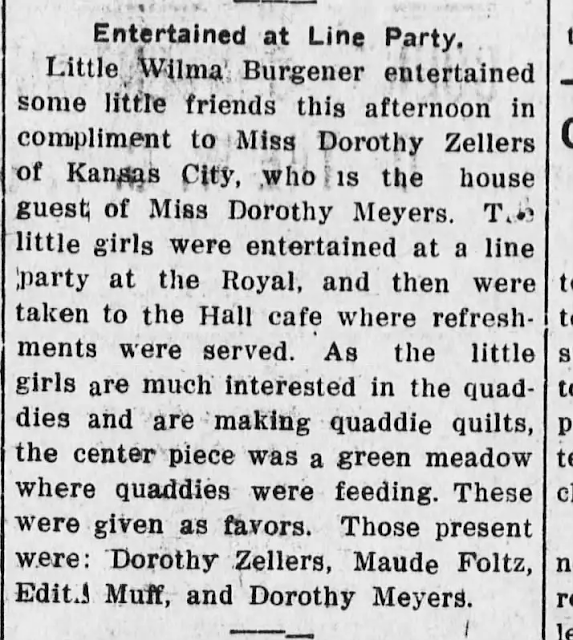
Soon the Quaddy Quiltie pattern was being syndicated all over the country.  There were even parties that featured a quaddy theme:


As I had discussed during the Story Time Stitches series, popular children's books often could be marketed in a variety of ways.  There were even "Bedtime Stories" party invitations marketed.

The success of the Quaddy Quiltie continued for years.  Would you make a Quaddy Quiltie for a child you know?

Have a safe and happy day!


Tuesday, May 16, 2023

Tuesday's This and That: May 16. 2022


Happy Tuesday!

I hope you are having a wonderful week!

I've lamented about quilts being cut up for apparel and crafts but interestingly enough, the idea of wearing patchwork is older than most of us had thought (take that designers of the 70s and present who think this is a cutting edge design).  The difference is that the patchwork apparel of yesteryear was not made of an intact quilt.  

Fashion Corner:  August, 1915: London England

"The Patchwork Skirt: Fashion's latest Freak in Colour Effects

Patchwork quilts are things of the past, but the patchwork skirt is the very last word in wearing apparel.

It comes from the States, where a pretty society debutante wore it recently at Newport, with a success so instantaneous that patchwork skirts are now the rule rather than the expception in that smart city by the sea, where rich Americans pass the summer.

But the patchwork skirt must be very carefully fashioned.  It can be a kaleidoscopic hues as the coat that Joseph possessed, but it must be cut according to the latest dictates of Madame La Mode.

You may remember that the more pieces were in the patchwork bedspread the better the handiwork was considered, and the pieces could be all sizes and shapes, round, oblong, square, heart-shaped, and oval.  The art came in fitting them together and blending the colours into a harmonious whole.

In the patchwork skirt, the pieces are sometimes larger, but they are various in shape, but they are various in shape, and are matched and blended with the same artistic care and placed on a lining cut in the prevailing fashion and fitted to the wearer.  The bodice is of crepe de Chine or chiffon in one shade or sometimes the patchwork skirt is worn with a little silk coatee of black or of a colour which predominates the pieces that compose the skirt..."


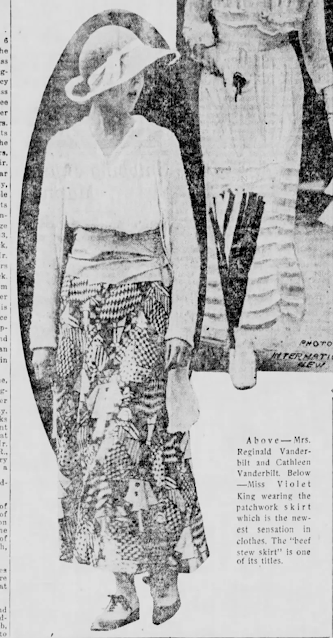
New-York Tribune, August 1915:


"Miss Violet King wearing the Patchwork skirt which is the newest sensation in clothes.  The "beef stew skirt" is one of its titles.

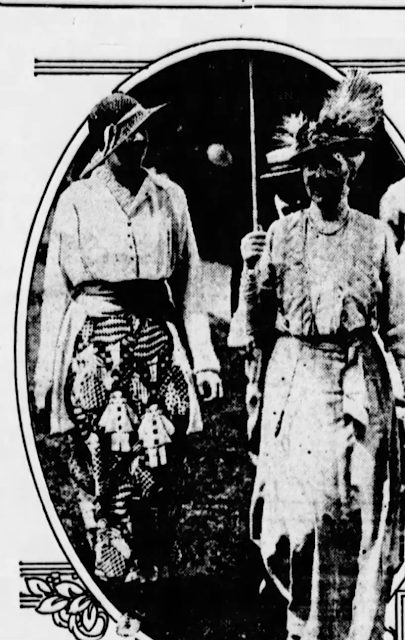
The Sun, (NY newspaper), August 1915:


Violet King (daughter of Congressman George Gordon King) may have been the originator of the fad because she is pictured here again (left).  Note the little harlequins on the skirt.  Actually studying the photos, I realized that this is the same skirt in both photos.

I don't much about Violet King but I believe she taught sewing at the Rhode Island Normal School.  

Wishing you a safe and happy day!


Monday, May 15, 2023

Ferns, Part 2


Happy Monday!

Well Sue answered my question about the mystery fern that appeared in my garden!

It's called "Sensitive Fern" and Sue even shared a video about it here.


Then I began to think about the fact that this is a fern normally found in wetlands.  I think that the wildlife brought spores into my garden.  I'm almost sure it was the foxes that frequent our backyard because they have a larger range of territory than the smaller animals and we live about 2-3 blocks from two different waterways in our parks.

Sue did more digging and found that the plants is referred to as "sensitive" because of its intolerance to cold...the plants die back with the first frost!

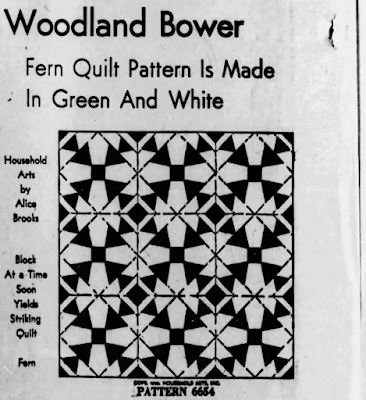
I also wondered about quilt patterns that used the word "ferns" in their title.  Only found one from 1940, an Alice Brooks pattern:


That was a bit disappointing since it didn't look like ferns to me at all.  I think Jocelyn has the right idea.  She said she picked ferns to use as an applique template.

Thanks Sue for sharing your sleuthing skills with us!

Have a safe and happy day!


Friday, May 12, 2023

Flower Friday: May 12, 2023

Happy Friday!


Today we are taking a tour around Sue's garden, she has a wealth of beauty growing in her garden!

Rock Cress Iris:


Lily of the Valley:


May Apples:


May Apple blooming:

Poppy:


Thank you Sue for sharing your amazing blooms!

Have a safe and happy day!



Thursday, May 11, 2023

Ferns in the Garden


Happy Thursday!

I think my favorite garden time is this part of spring.  I like the lush variety of greens and the occasional pops of color.  There's something about these greens that are soothing.  I'll appreciate the chaos of colors in the garden when summer arrives but it is not as soothing as they serene spring days.

Ferns have a magical impact on gardens.  I like them because they remind me of my Nana Elsie's garden.   In the last two years, I've noticed that the Japanese Painted ferns have sprung up...but not anywhere near the original plants.

There are now some in my front yard, and near the swing (in the far back yard) and the only thing I can deduce is that some of the wildlife transported the spores of the fern...especially because the places that my dogs have never gone.

And we have a whole new fern and I'm not sure what kind of fern it is at all but it is in a few places in the garden--especially where the animals have dug an entrance/exit under the fence.

Do you know what kind of fern this is?


Tomorrow is Flower Friday and I've received a few photos already!  Please share your photos by emailing me at allentownquilter@gmail.com!

Have a safe and happy day!


Wednesday, May 10, 2023

Designs Still Worth Doing: A Celebration of Ruby Short McKim, Prologue


Many of us are familiar with the work of Ruby Short McKim.  She was a famous quilt designer in the first half of the 20th century.  Like you, I was somewhat acquainted with her work.  I sure did know her book, One Hundred and One Patchwork Patterns: it was the first book I used for quilting when I attempted to use templates way back in the early 1970s.  

I also knew of her embroidery patterns that used hard angled illustrations.  But it wasn't until a few years ago that I really began to seriously study her work.  At the time, the centennial of the publication of McKim's first quilt pattern approached and I decided to research her more completely.


Now there's a lot of sites on the internet that talk about Ruby's history, my favorite biography appears here on the Quilters Hall of Fame.  I wanted my program on this interesting designer to be different than just showing old quilts and talking about her life.  I decided (for the first time ever) to remake some of her pieces as a tribute because in fact, Ruby McKim's designs are still worth doing.

Perhaps you will decide that you would like to make one or more of the pieces I show on the blog.  Many of McKim's patterns are available at the McKim Studio website here.  

Have a safe and happy day!