Showing posts with label Part 2. Show all posts

Thursday, February 16, 2023

Paper Quilts, Part 2

 Today I'm continuing the brief but interesting phase of what was called "paper quilts" by journalists.   Although I've never read a book that mentioned the phrase per se, I found enough newspaper articles to draw a fairly good rendering.

There is always a lot of talk about what folks used as batting in their quilts.  Years ago, quilt historian Xenia Cord did an article for AQSG on unusual things found inside of old quilts--the most memorable item being a mid-century rubber bath mat.  Beth and I found in one of my quilts, a part of a pieced petticoat and a cut-up child's sailor shirt:

The petticoat 

But these items (I always assumed) were used as necessity--items that were ingeniously upcycled by quilters to keep their families warm with what they had on hand.

Paper quilts on the other hand seemed like a genuine fad.  It was repeatedly published as a viable type of quilt batting from the late 19th century until the early 20th century.  

I wanted to know why.

The main reason may have been because of cotton crop failures.  Beginning in the 1890s, crops were devastated by the boll weevil which first destroyed cotton in Texas and gradually spread throughout the south.
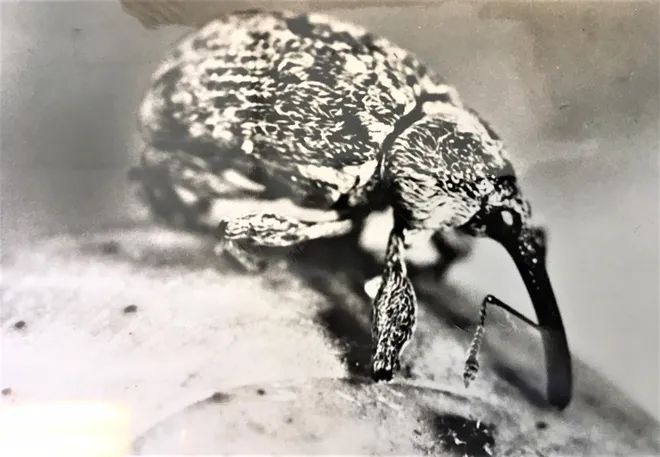
The boll weevil feeds on the buds and flowers of the cotton plant.  The above photo was taken when the insect invaded Georgia in 1919.  Below is a map published that illustrated the path and dates of the insect:


It doesn't take an economist to realize that shortages created higher prices.  Perhaps that is one reason newspapers continued to report about this type of batting.

Many articles cited that paper quilts were warm:

1909: Topeka, Kansas.


1912: Akron, Ohio

My theory on this is that paper is not unlike polyester.  Cotton is "breathable"; polyester is not which makes it warmer.  Possibly paper shares the same properties (?).  It didn't hurt that paper was a cheaper alternative either.

By the time World War 1 broke out, quilts using paper batting were reported in Canada, England, and other countries.  This was partially due to the lack of importation of cotton to Europe.  Here in the United States, a variety of articles cited that one could use newspapers for a variety of purposes.


As for the claim by the paper quilt manufacturer (posted yesterday) that it was more hygienic to use paper quilts than traditional quilts--well I am sure that was just marketing.  I couldn't find a single article that explained how one cleans a paper quilt (although as the article states above, one could replace the quilt).

Still, it seems like paper was often used during this time period.  When I googled the subject, I found a lot of quilters and historians who knew of newspapers and paper being used for batting (see here).

Why was the practice abandoned?  Well I'm wondering if the technique was used again during the Depression.  Can't you just hear someone saying, "Grandma used paper for her quilts way back when..."  But--I haven't found any documentation for this.  It isn't like we see a lot of quilts with paper batting inside of it.  In all likelihood, paper quilts didn't survive the test of time as utilitarian quilts often do not.  

Probably most significant was that in the early 20th century, newspapers also began to suggest using a blanket of flannel or wool in the center of one's quilt:

Above--1907: Nashville

1910: Boston

This technique I've frequently seen in old quilts and you probably have too if you study quilt history.

One last thing that makes me catalog "paper quilts" as a fad--the inclusion of the technique into humor.  Here is a popular syndicated joke that brings new meaning to the term "bed and breakfast":


Tomorrow is Friendship/Flower Friday.  If you have anything to share, please email me at allentownquilter@gmail.com

Have a safe and happy day!


Thursday, February 24, 2022

Aprons...All Tied Up, Part 2


Sheet music circa 1880, 
"That Old Checkered Apron."

There are some aprons that I have great admiration for:  The egg gathering apron that I learned about when one of my friends had or made one.  Multiple pockets are featured on the apron and each pocket is for an individual egg. There are lots of examples on Etsy.

The harvest apron as it is called now, was good for eggs but really good for picking produce.  I wish I had one every time I am picking tomatoes in our garden.

I think the clothespin apron is much more functional than clothespin bags:

Sewing aprons protected ladies' dresses from lint and thread and often had a large open pocket at the end of the apron to catch thread and scraps.  The aprons were usually full and covered more of the clothing.  One article said they should always have pockets for the seamstress.  Of course that didn't prevent some manufacturers to market a decorative "sewing" apron:

But what about the other kinds of apron?  One of my favorite is the "Hoover Apron" which became popular during World War 1.  Named after Herbert Hoover, "the food czar", who headed up the Food Administration.  The apron was part of the Food Conservation Program and women could buy or make aprons and--if they signed a pledge to uphold the conservation program--they could sew a special badge onto their aprons.  Here's a fine front page headline from the Spokesman-Review (Spokane, Washington) in 1917:


Women really liked this apron.  They continued to wear variations of the apron after the war.  And then there was this headline from 1919:


😂😂😂

While searching for the Hoover apron, I found the Bungalow Apron...
1918

And another style is here, fourth apron pictured:

Rubber and oil cloth aprons added the ultimate protection:

Here is another aspect I'm curious about.  There were aprons that were pinned onto a woman's dress.  That style goes back to the 19th century and remained popular throughout the first half of the 20th century:


These confuse me.   Did the woman show the safety pins?  Or were special pins outside the apron?  Did you have to take your dress off or loosen it to get the apron pinned on properly?

This concludes my thoughts on early 20th century aprons.  I hope you don't mind these posts.  I've been trying to concentrate on something other than the news...prayers for the people of Ukraine this morning.  Enough said.

Tomorrow is Friendship Friday.  If you have anything to share, please email me at allentownquilter@gmail.com.

Have a safe and happy day!


Wednesday, November 10, 2021

Story Time Stiches: Absentees, Part Two

 Our look at quilts and children's books continues with some interesting omissions to the study.  If you've seen any of these characters sewn in a quilt, please let me know!

2. Notable Exceptions:


Uncle Wiggily Longears was first published in 1910.  According to Wikipedia, Howard R. Garis wrote a story a day (except Sundays) for 52 years and published 73 books.  Many of his books and the Uncle Wiggily Game are still available for purchase.  The character was widely popular so it seems odd to me that I've never seen an Uncle Wiggily quilt or quilt kit.  I have seen vintage fabric that measured 34 inches wide which may mean that the fabric was vintage:


There was even a pattern for Uncle Wiggily stuffed toys:

Interestingly enough, the books and the Uncle Wiggily game are still available to purchase!

💟💟💟


In 1924, Howard Gray's comic, "Little Orphan Annie" debuted and was widely popular.  There are a lot of vintage quilts out there but they derive from the Broadway musical/movie from the 1970s.  This is all very interesting to me because of the popularity of the radio show and there was even a 1938 movie:

I personally think that the reason for the lack of quilts was fairly simple.  Orphanages were all over the country and it was probably a family's biggest fear--especially during the Depression-- that their children might end up in an orphanage. 

💟💟💟


Frank Baum's book, The Wonderful Wizard of Oz was published in 1900.  There were lots of sequel books and I read a lot of them as a child.  For some reason, I thought this past week that there was an embroidered coverlet quilt pattern offered in an early 20th century magazine.  But I can't find it now and it may be my memory fails me.  After the movie was released in 1939, there were possiby linens available.  This sheet is featured on Worthpoint and I don't know how accurate the date is (it seems unlikely to me but what do I know about sheets?):

This quilt became very popular in the 1970s and I have one in my collection:

💟💟💟


"It is the Gruelle ideal that books for children should contain nothing to cause fright, suggest fear, glorify mischief, excuse malice or condone cruelty," wrote Johnny Gruelle about his books.  

Gruelle's first Raggedy Ann and Andy book was published in 1918.  There may be an actual legal reason for it.  In her book, Johnny Gruelle Creator of Raggedy Ann and Andy, Patricia Hall writes of a copyright infringement lawsuit that Gruelle had to bring against a dollmaker.  The Philadelphia dollmaker marketed her dolls as "Official Raggedy Ann and Andy Dolls" without the consent of Gruelle.  Gruelle won the case eventually.

It wasn't until well after Gruelle's death in 1938, that the licensed figures could be used in a variety of kit quilts, mostly in the 1970s and beyond:

💟💟💟

Stay tuned for our next installment!

Have a safe and happy day!


Thursday, June 3, 2021

Story Time Stitches: Connections, Part 2


1.

The development of children's literature really began in the 18th century.  Children's books before that--when they were available to the general population--tended to be religious in nature like A Token For Children by James Janeway.  Janeway was a Puritan minister and among other things, the book features the deaths of 13 children who were grateful to go to Heaven:

2.

More strides were made in the 18th century.  In particular I'd like to focus on John Newbery of England.  He believed that the philosopher John Locke was correct when Locke suggested that the best way to teach children was through amusement.  Newbery is considered "The Father of Children's Literature" and the publisher's most famous book is The History of Little Goodie Two-Shoes which has a theme familiar with many fairy tales like Cinderella.  The book was published in 1765:

Newbery proved that children's literature could be profitable and at it is he who is honored by the Newbery Medal;   each year since 1922, American librarians celebrate "the most distinguished contributions to American literature."  It is the highest honor given to a children's writer.

In the early 19th century, the Grimm brothers book of fairy tales was introduced in England in 1824.  The illustrations were by George Cruikshank and are credited with being more dynamic than previous children's books:
Cruikshank's illustration for "The Goose Girl"

The real changes in illustrations for children occurred between the 1880s and 1920s.  It is referred to as "The Golden Age of Illustration" and included many of the illustrators we will discuss.

All of the connections discussed yesterday contributed to the rise of illustration but there was one other art movement that also was integral: The Aesthetic Movement.  From 1860 to 1900, this movement altered the perception of art.  Aspects of the philosophy relevant to illustration included "art for art's sake", that art should be available to the general masses, and that crafts should be embraced like ceramics, metalwork, fashion, and yes, illustration.

Despite the disdain of people in the "high arts" aka the fine arts, illustration fulfilled one of the concepts of the Aesthetic Movement.  Illustration was extremely popular with the general public.  People of limited means decorated their homes with colored illustrations.  All types of illustrated works were collected and used.  One way the illustrations were integrated were screens comprised of collages of illustrations--see here for an excellent example.


Scrapbooks that often featured only illustrations were assembled and it was not just a hobby for young girls or women.  One of the books in my collection is a scrapbook by Samuel Maucher and dated 1881.  A page from Samuel's book:

Illustrations were so popular that businesses used the cards to advertise.  The concept was not unlike the calling card and usually similar in size.  The products were referred to as trade cards and were not only popular then but are still sought by collectors today.
Companies like McLaughlin's Coffee often included a trade card with the purchase of the product.  The illustrations often were in a form of a series which could be collected by the consumer.  The series could be in the form of children's lives (above), stories, or even historical or current events:
This trade card portrays the christening of Grover Cleveland's second child Esther.  

Other cards simply advertised a product or a company.  Almost any kind of business could advertise like this including sewing companies:


The last factor that I need to touch on is one that directly impacted illustrators:  the rise of the greeting card.  In the mid-19th century, companies began to sell illustrated greeting cards.  By 1860, mass production made the cards more affordable to customers.  As you will learn, many of our illustrators began their careers in this field before the work with book publishers.  
This trend of greeting cards-to-book illustration continues today.  Mary Engelbreit and Sandra Boynton are two examples that come to mind.
Illustrator unknown

Magazines also employed illustrators which increased the popularity of their magazines.  Illustrators like Randolph Caldecott (as in the Caldecott Medal given in this country to the artist who created the most distinguished picture book in a given year) first were employed in magazine illustration.

All of these aspects contributed to the rise of illustration.

Next week we will begin with our first illustrator and yes, look at quilts.  

Tomorrow is Flower Friday and if you have any images you would like to share, please email me at allentownquilter@gmail.com

1. 1894 etching of children reading.  Artist unknown.

2.  A Token for Children was published in England in 1671-1672.

"Story Time Stitches" © 2021, Michele McLaughlin