Tuesday, June 8, 2021

Tuesdays This and That


So I found another blog post that intrigued me (we're having a heat wave so I'm in the house a lot more).   I'm intrigued by this block that I found on the Quilting Patchwork Applique blog.  This is the blog of a French quilter and I like to follow her work.  Her post that intrigued me is a block or technique she called Hungarian Squares Pattern.  You can see the block here as well other photos of her friends who also used the technique.  It reminds me of a Cathedral window and also maybe something I've seen on a Japanese quilt...but I'm not sure.  Have you seen this before?  It is really neat and I would like to know if there is another name for this block.


About a month ago, bloggers were informed that our readers will not be able to get our posts through email.  The company that does that is discontinuing the service in July.  I wanted to tell you that now so you can bookmark the blog or follow me through bloglovin (see the bloglovin' link to the right of the post).


On a whim I looked through newspaper articles a hundred years ago.  Most of the articles started with:  An old fashioned quilting party was held at Mrs.  So and So's house.  But I liked this ad about a quilt contest held in Des Moines, Iowa.  Quilting contests before the Depression tended to be a way to interest children in quilting.  The quilts were usually embroidered blocks that could be assembled  into a top with the assistance of an adult. 


Love the illustration of a child fondly admiring her quilt!

Even though the article doesn't mention the designer in this ad, this quilt appeared to be a Ruby McKim design.  She was a very popular designer for these kinds of contests and made her first real splash into quilt design with the Quaddie Quilt in 1916.

Later updates in the newspaper confirmed the designer:

McKim's Nursery Rhyme Quilt

Some of us of a certain age remember that the local newspaper had a special section for children.  Unfortunately, some of those pages aren't all included in most of the newspapers I've studied. 

I never did find out who won the contest or what kind of prizes were given.  But I found a sweet article a year later.  The article appeared before Christmas and shared what children in the hospital were hoping to get for Christmas.  

"Last year some small quilts with Mother Goose stories in outline were received," said one of the doctors.  "We placed them on the beds of the sickest children and the results were better than the most potent medicines could have obtained."

I leave you on that note and the healing powers of our quilts!

Have a safe and happy day!


Monday, June 7, 2021

Inspiration and Conversational Prints

 Sometimes you get tired of a particular type of fabric.  Both Beth and I mused about this during the past year.  We had gotten tired of our 19th century reproduction fabrics.  The one exception was that we still adored shirting fabrics.

I love 19th century conversational prints.  They were a style of shirtings popular from about 1880 into the 20th century.  I bought a lot of reproduction fat quarters of the prints at the Lancaster Quilt Show about 17 or 18 years ago.

Excuse the color or lack thereof.  I photographed these early in the morning!

I use these fabrics sparingly because I really love them!

I read that they were often used for men's shirts in particular.  It makes sense because some of the prints seem more masculine.  I couldn't imagine a woman wearing a shirt with baseball players, crickets playing pool or fishing rods:


But of all the ways that I have seen these prints used, I have never seen anyone use them the way that Wendy Caton Reed used them in a quilt called Happy Hexagons.  I've mentioned Wendy before.  She has a blog called The Constant Quilter and her work is currently on display at the New England Quilt Museum.  I know I mentioned that before as well.  But you need to SEE more of Wendy's quilts.  

I saw the Happy Hexagon quilt on a post at the GladiQuilts blog and I have to say I am crazy about this quilt and the way Wendy used her conversational prints.  You can see it on Gladi's blog here.  I must have looked at this quilt 5 times this week.  But I want you to see more of Gladi's photos of Wendy's work here and here (check out the Esther's Cheddar Casserole Quilt!) and here .  

I really think of Wendy as an artist.  She's made me re-evaluate my stash and I'm taking a fresh look at my 19th century reproduction fabrics.  Thanks for the inspiration Wendy!  I'm also super grateful for Gladi's blog this week!  You should also check out the photographs she posted from the Pilgrim/Roy Collection as well!  

Have a safe and happy day!


Friday, June 4, 2021

Flower Friday: June 4, 2021

 Happy Flower Friday!

Happily, we are getting some wonderful rain after 3 dry weeks!  Let us know how your weather and garden is doing!

Sometimes a section of a garden can just make you happy to see it.  Linda loves the combination of these colors in her garden!  It really is soothing and happy!


This little corner of my garden has been making me happy.  I don't even mind that a lot of things are smooshed from the rain!


Here are some images of Lorraine's garden this week.  Aren't they lovely?


Other flowers from Lorraine's garden:


Other things in the garden make us happy.  Betsy sent a photo of what she thinks might be heirloom peonies.  She got them from a friend who lived in a late 1700s farmhouse!

I do have a question for you gardeners and I hope you can help me.  I found this plant in my garden.  I think it is a squash or maybe a cucumber (Denise my neighbor guessed zucchini).  Do you recognize it?  It must have been sowed by a bird or the wind.  Since we got rain, it has jumped to about twice this size!
And now these seedlings are coming up in a different part of the garden but I think are similar to the above plant:


Do you know what this plant might be?
Inquiring minds want to know!

Thank you and have a safe and happy weekend!


Follow my blog with Bloglovin


Thursday, June 3, 2021

Story Time Stitches: Connections, Part 2


1.

The development of children's literature really began in the 18th century.  Children's books before that--when they were available to the general population--tended to be religious in nature like A Token For Children by James Janeway.  Janeway was a Puritan minister and among other things, the book features the deaths of 13 children who were grateful to go to Heaven:

2.

More strides were made in the 18th century.  In particular I'd like to focus on John Newbery of England.  He believed that the philosopher John Locke was correct when Locke suggested that the best way to teach children was through amusement.  Newbery is considered "The Father of Children's Literature" and the publisher's most famous book is The History of Little Goodie Two-Shoes which has a theme familiar with many fairy tales like Cinderella.  The book was published in 1765:

Newbery proved that children's literature could be profitable and at it is he who is honored by the Newbery Medal;   each year since 1922, American librarians celebrate "the most distinguished contributions to American literature."  It is the highest honor given to a children's writer.

In the early 19th century, the Grimm brothers book of fairy tales was introduced in England in 1824.  The illustrations were by George Cruikshank and are credited with being more dynamic than previous children's books:
Cruikshank's illustration for "The Goose Girl"

The real changes in illustrations for children occurred between the 1880s and 1920s.  It is referred to as "The Golden Age of Illustration" and included many of the illustrators we will discuss.

All of the connections discussed yesterday contributed to the rise of illustration but there was one other art movement that also was integral: The Aesthetic Movement.  From 1860 to 1900, this movement altered the perception of art.  Aspects of the philosophy relevant to illustration included "art for art's sake", that art should be available to the general masses, and that crafts should be embraced like ceramics, metalwork, fashion, and yes, illustration.

Despite the disdain of people in the "high arts" aka the fine arts, illustration fulfilled one of the concepts of the Aesthetic Movement.  Illustration was extremely popular with the general public.  People of limited means decorated their homes with colored illustrations.  All types of illustrated works were collected and used.  One way the illustrations were integrated were screens comprised of collages of illustrations--see here for an excellent example.


Scrapbooks that often featured only illustrations were assembled and it was not just a hobby for young girls or women.  One of the books in my collection is a scrapbook by Samuel Maucher and dated 1881.  A page from Samuel's book:

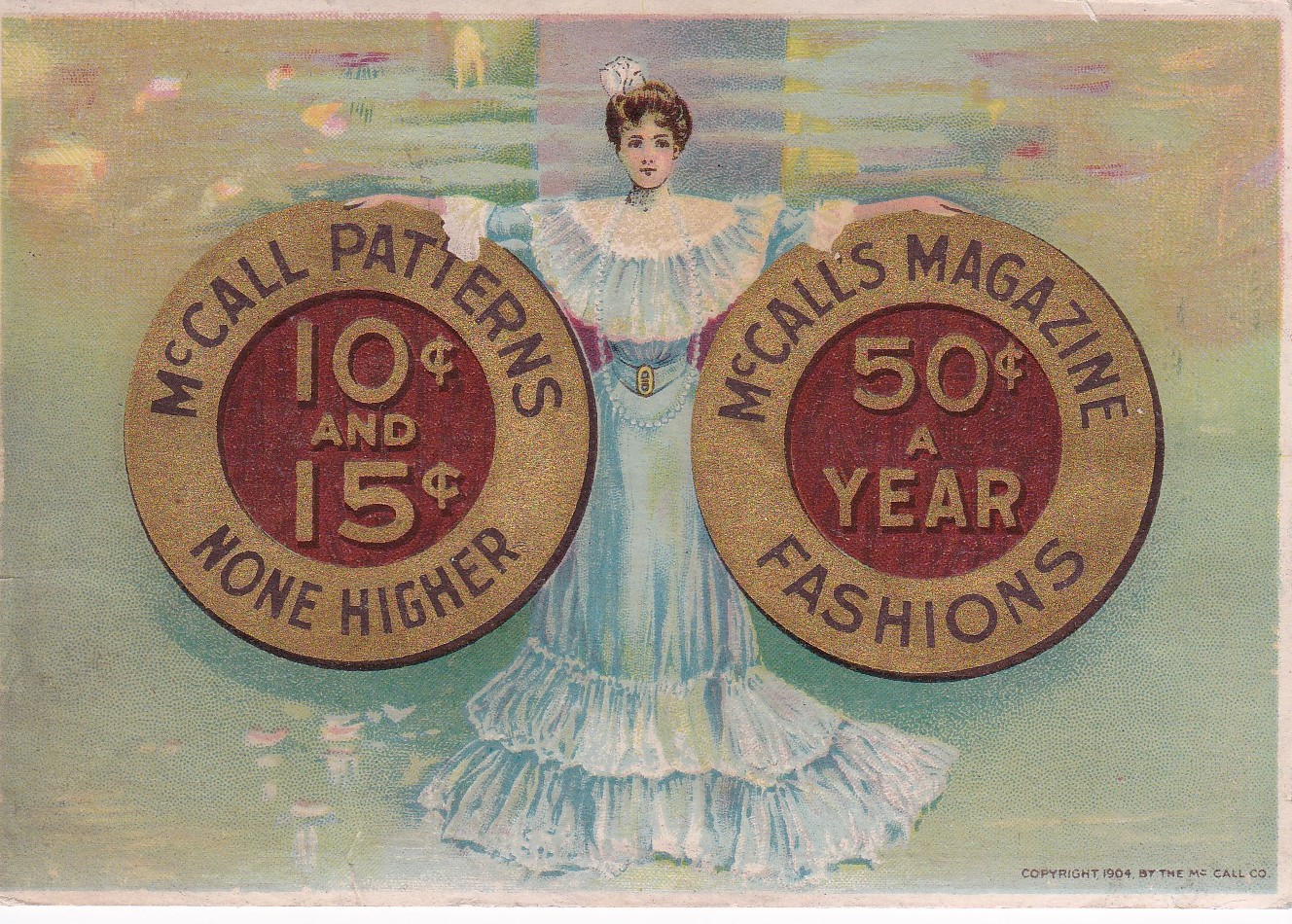
Illustrations were so popular that businesses used the cards to advertise.  The concept was not unlike the calling card and usually similar in size.  The products were referred to as trade cards and were not only popular then but are still sought by collectors today.
Companies like McLaughlin's Coffee often included a trade card with the purchase of the product.  The illustrations often were in a form of a series which could be collected by the consumer.  The series could be in the form of children's lives (above), stories, or even historical or current events:
This trade card portrays the christening of Grover Cleveland's second child Esther.  

Other cards simply advertised a product or a company.  Almost any kind of business could advertise like this including sewing companies:


The last factor that I need to touch on is one that directly impacted illustrators:  the rise of the greeting card.  In the mid-19th century, companies began to sell illustrated greeting cards.  By 1860, mass production made the cards more affordable to customers.  As you will learn, many of our illustrators began their careers in this field before the work with book publishers.  
This trend of greeting cards-to-book illustration continues today.  Mary Engelbreit and Sandra Boynton are two examples that come to mind.
Illustrator unknown

Magazines also employed illustrators which increased the popularity of their magazines.  Illustrators like Randolph Caldecott (as in the Caldecott Medal given in this country to the artist who created the most distinguished picture book in a given year) first were employed in magazine illustration.

All of these aspects contributed to the rise of illustration.

Next week we will begin with our first illustrator and yes, look at quilts.  

Tomorrow is Flower Friday and if you have any images you would like to share, please email me at allentownquilter@gmail.com

1. 1894 etching of children reading.  Artist unknown.

2.  A Token for Children was published in England in 1671-1672.

"Story Time Stitches" © 2021, Michele McLaughlin


Wednesday, June 2, 2021

Story Time Stitches: Connections, Part 1


1.

Storytelling may be the oldest of arts but finding images on quilts that reflect popular books--particularly children's books--is a relatively new phenomenon.  A number of factors culminated to form the illustrated and colored children's books that we find copied onto textiles.

2.

The first factor was the Industrial Revolution.  Because of the rise of factories, a middle class arose of bureaucrats,  merchants, and skilled workers.  As economic opportunities increased a new set of social standards were created.  

3.

Women were now considered the abiters of taste and the moral keepers of the home.  Discussion on women's rights and independence fermented.  By the end of the Civil War, "female" colleges were established throughout the United States.  Many women sought financial independence.  One writer has suggested that there may not have been much resistance to women working because of two reasons:  the astonishing loss of men during the Civil War and the fact that many men may have not wanted to support unmarried women family members.  (4)

As the women's movement in the the United Kingdom and the United States evolved, women were finally given a place in the arts--not the fine arts--but illustration became one of the acceptable areas for women to work during the last quarter of the 19th century.

The Industrial Revolution also contributed to many improvements in various industries.  Sewing machines became more affordable after the Civil War and provided women more leisure time.  

In 1875,  William Briggs patented the first iron-on embroidery transfers in England.  His patterns were marketed in the United States and were immensely popular.  Pictured below is one of his transfers:

Women no longer needed to know how to draw in order to embroider images on quilts and linens.  In the 19th century, embroidered transfers were often incorporated in what I consider to be the first two national trends in quilting:  crazy quilts and redwork.  By the end of the 19th century, there were even books that encouraged women to use iron-on transfers to establish their own businesses:

5. Dainty Work for Pleasure and Profit

Book publishing also improved and colored illustrations could be included in a variety of books--even those for children.  After the Civil War, more magazines for women emerged.  Women read about a variety of topics including child rearing, domestic matters, and sewing.  Many magazines even included free patterns that women could incorporate in their sewing.

(6)
But the population that was most impacted by the changes in society were children. 

In lectures I sometimes joke that the Victorians invented a thing called childhood.  With the changes of family life and the influence of Queen Victoria (both in the U.K. and here), attitudes towards children softened.  Children were no longer "born bad and had to be made good." Instead they needed protection and their young lives were viewed as having a seperate stage of life that required special care.  (7)

Children were still disciplined but in a measured way.  Most of all, a new territory in the household was allotted to them:  the nursery.

Education also improved.  Public schools were opened in the 19th century (versus religious institutions) and the Department of Education was established as a government branch after the Civil War. Libraries reflected the social attitude and special "children's areas" were created that encouraged children to read.

These changes greatly changed society, not only for the children and families but also the economy.  Businesses emerged that specialized in products for children--such as toys, books, etc. 

Most importantly, it needs to be pointed out that many of these changes were reflected in families who had a comfortable income.  Childen of poor families continued to work in factories and often in deplorable and dangerous conditions.

Tomorrow I'm going to have a special part 2 of this week's series and focus on children's books and illustration.  

Have a safe and happy day!
***

1.  Cover of Good Housekeeping magazine, February, 1920.  Illustration by Jessie Wilcox Smith

2. Samuel Slater is considered "The Father of the Industrial Revolution" in the United States.  Pictured is The Old Slater Mill in Rhode Island.

3.  Fashion Plate from Godey's Lady Book (a popular magazine for women), 1859

4.  See The Red Rose Girls, An Uncommon Story of Art and Love by Alice A. Carter, copyright 2000.

5. Fancy Work For Pleasure and Profit, first published in 1893.  The book was published the same year as the World's Columbian Exposition.  The book is dedicated to  Mrs. Potter Palmer who was the "President Board of Lady Managers of the World's Columbian Exposition."   You can read the book online here.  

6.  Design by Candace Wheeler and published in Harper's Bazaar, June 4, 1892

7. An excellent book on this subject is Huck's Raft:  A History of American Childhood by Stephen Mintz.

"Story Time Stitches" ©2021, Michele McLaughlin

Tuesday, June 1, 2021

Tuesday's This and That!


Happy Tuesday!  I hope you all had a good weekend!

It's Tuesday so let's share some news!

After the first installment of Story Time Stitches, many of you had memories to share:

Robin commented and reminded me of a story I had forgotten about, "Snow White and Rose Red"!  Robin wrote:

"Eloise Wilken's illustrations are my favorite. She was able to tell the stories without any words. My favorite is Baby Dear. I had a baby brother and was about 10 yrs. old when this book came out. There were no siblings between us so he was very precious to me. The illustrations made me feel so safe. My favorite was the illustration showing the mother holding the baby in front of a picture window with a sunset in the background. I have a badly worn copy of that book. I also have Baby's 1st Christmas. Other book illustrations I loved were "Snow White and Rose Red" in the Book House Books and the "Musicians of Bremen" in The Tall Book of Fairy Tales, Harper Collins Publishers."

Susan also loved My Dolly and Me and still has her copy!

Karen can relate and remembers a 1950's book that fascinated her at the doctor's office when she was a child.  All she can remember was that it was about a little blonde boy's first day of school.  If you have that book seems familiar to you and you know the title, let us know!

Judy and I mused about how well we can remember these books we loved.  She suggested that maybe reading the Little House on the Prairie series might have influenced her love of fabrics from the 1800's to 1920's!  It's interesting to look back on what influenced us as youngsters and discover how relevant it is in our adult choices!!!


Since we are speaking of the Little House books, most of us grew up with the illustrations of Garth Williams in our books.  The original illustrator was Helen Sewell and there is an interesting article here you can read.


And because it is Tuesday, here's another tid-bit:  Jacqueline Atkins wrote a variety of books on Japanese quilting.  She spoke to our guild and also I think she spoke at an American Quilt Study Group conference.  I liked her a lot and at one time had one of her books (can't find it now).  What fascinated me about her lecture was when the Japanese adopted making quilts.  According to Atkins--and I hope I have this right--although there was always a tradition of quilted clothing and even armour, quilts did not become popular until the Japanese began watching a show in the 1970s called The Little House on The Prairie.
****

Just a reminder: The Fat Quarter Shop still is posting free patterns for the Sewcialites quilt here.  I think the series will end in a few weeks, so if you are interested, I would download your patterns soon!
****
Have a safe and happy day!